
The Great Tech Comeback: Why Old Technology Is Cool Again
For years, technology has followed a fairly predictable pattern.
Something new comes along. It's faster, smaller, smarter and packed with more features than the version before it. We replace what we already own, move on and rarely look back.
Except lately, younger generations especially have been making use of older tech.
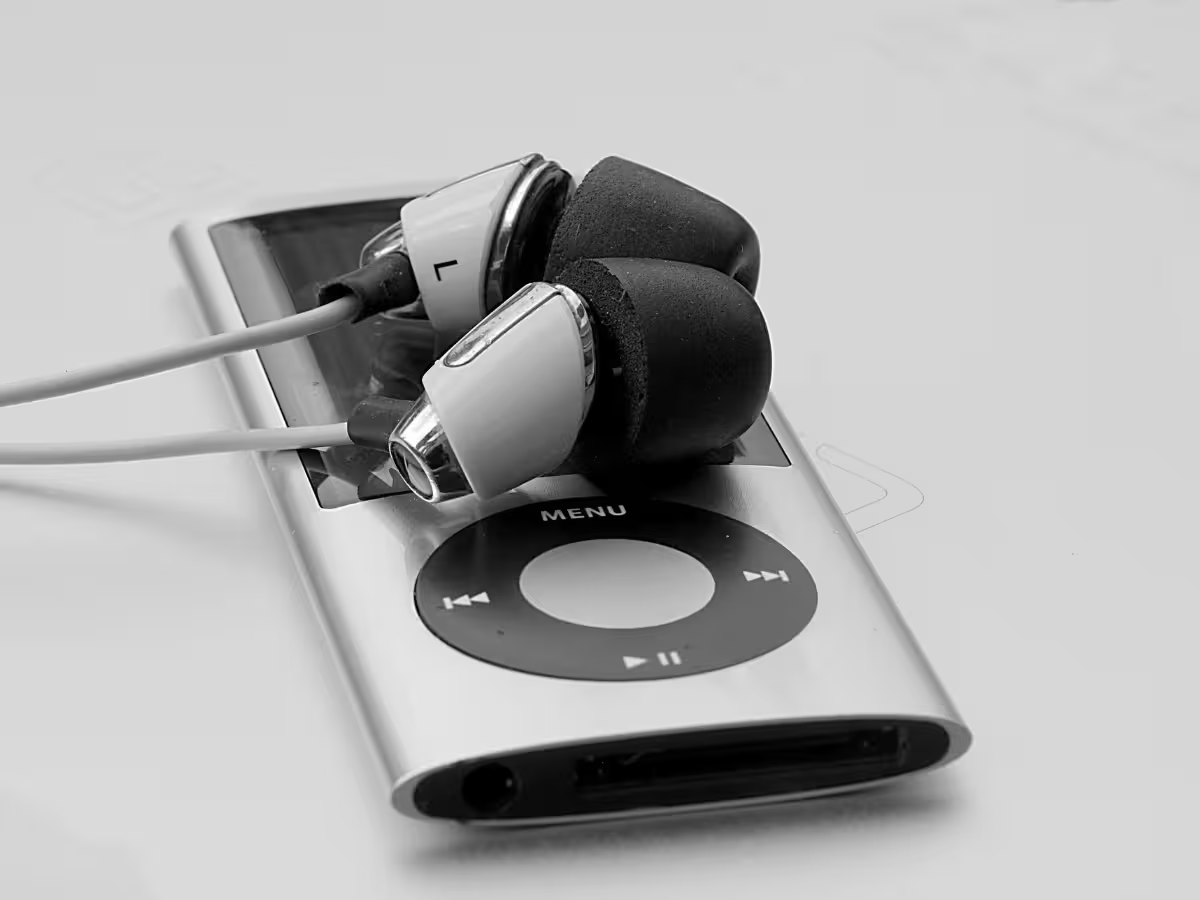
Digital cameras are making a comeback. Wired headphones are appearing in public again. Old iPods and MP3 players, once abandoned in drawers and forgotten about, have become desirable.
Even flip phones and so-called "dumbphones" are finding a new audience.
To the average person, the phenomenon all seems slightly strange at first. After spending years trying to make technology wireless, connected and capable of doing absolutely everything, why are people suddenly interested in devices from 10, 15 or even 20 years ago?
The answer is more interesting than simple nostalgia.
Digital Cameras Are Back
Smartphones have made photography easier than ever.
Most people carry a high-quality camera in their pocket at all times, capable of taking thousands of photos, editing them instantly and sharing them with the world in seconds.
By almost every technical measure, modern smartphone cameras are extraordinary.
Yet older digital cameras are becoming increasingly popular again.
Part of the appeal is the look. Images taken on older compact cameras can be grainier, less polished and more unpredictable than the perfectly processed photographs produced by modern smartphones.
For some people, that's exactly the point.
Modern technology has spent years chasing perfection. Sharper images, brighter screens, faster processing and increasingly sophisticated software have made our devices incredibly capable.
But there is something appealing about technology that doesn't get everything quite right.
An old digital camera has its own character. The photographs might not be perfect, but that's often what makes them interesting.
There's also something to be said for using a camera purely as a camera.
You take a photograph, put the camera away and continue with your day. There are no notifications waiting for you. No temptation to check social media. No immediate urge to edit the image, upload it and see who has liked it. For most people joining this movement, it's a much simpler and purer experience.
Wired Headphones Never Really Went Anywhere
There was a time when wired headphones felt like a problem waiting to be solved.
The cables tangled in pockets. They caught on door handles. You had to remember which side was left and which was right.
Then wireless headphones arrived, and for a while, it seemed inevitable that cables would disappear altogether.
Now wired headphones are back.
Part of that is fashion, of course. Technology has always had a habit of becoming retro before becoming fashionable again.
But there are practical reasons too. Wired headphones don't need charging. They don't need pairing. There is no battery to run out halfway through a journey. You simply plug them in and they work.
There is also a growing appreciation for technology that does one job without needing an app, subscription or software update to make it happen.
The Return of the iPod
Perhaps the most surprising comeback has been the renewed interest in old iPods and MP3 players.
For years, the smartphone replaced the dedicated music player. Why carry two devices when one could do everything?
But doing everything can also be part of the problem.
Listening to music on a smartphone means carrying around the same device used for emails, messages, work, social media, news and countless other distractions.
An iPod simply plays your music as and when you want it, and there seems to be something increasingly appealing about a device with such a clear purpose.
You can listen to an album without receiving a work notification. You can go for a walk without opening social media. You can choose what to listen to without being immediately presented with an algorithm telling you what it thinks you should hear next.
In a world where our phones are designed to keep our attention for as long as possible, a device that simply plays music can feel surprisingly refreshing.
Why Are We Going Backwards?
Of course, we're not really going backwards. Very few people are giving up their smartphones entirely or replacing modern technology with devices from the early 2000s.
The renewed interest in older technology is more about choosing when and how we use different devices.
Work, entertainment, communication and social media all compete for our attention in the same place, but using separate devices creates a little distance.
The Appeal of Physical Technology
There is another reason older devices have found a new audience: they feel different.
Older technology has buttons.
You turn a dial. You press play. You click through a menu. You insert a memory card.
For years, technology design has moved towards making everything smoother, thinner and increasingly invisible. Physical buttons have disappeared, cables have been removed and screens have taken over.
Modern devices are often beautifully designed, but they can also feel remarkably similar.
An old iPod has a click wheel. A compact camera has physical controls. A wired set of headphones has a cable you can actually see and hold.
These details might seem insignificant, but they change the experience of using the technology.
Perhaps that's part of the reason people are rediscovering them.
Is Newer Always Better?
This is where the comeback of older technology becomes particularly interesting.
Newer technology is often better. Processors improve. Batteries last longer. Screens become clearer. Security and software evolve.
Progress matters.
But newer doesn't automatically mean that older technology has stopped being useful.
A five-year-old laptop may still be perfectly capable of handling everyday work. A business desktop that has been replaced by a newer model may have plenty of useful life left. A device can become unsuitable for one purpose while remaining more than capable of doing another.
This is something we see regularly in the world of IT.
Businesses often replace equipment because they need to get the latest up-to-date model. That doesn't necessarily mean the equipment itself has no value, as for another user or another environment, it may still be perfectly suitable.
The question isn't always whether something is old, the more useful question is whether it still does what someone needs it to do.
What the Retro Tech Trend Can Teach Us About Reuse
For decades, the technology industry has encouraged us to focus on what's next: The newest model, the latest features or the next upgrade.
There's nothing wrong with new technology, and there will always be situations where replacing older equipment is the right decision.
But replacement doesn't have to mean waste.
Technology that has reached the end of its life in one environment may be suitable for reuse, refurbishment or redeployment elsewhere.
That principle sits at the heart of the circular economy.
Before getting rid of old equipment, it's worth asking whether it still has useful life left. If it does, keeping it in use for longer can reduce unnecessary waste and make better use of the resources already invested in manufacturing it.
Maybe We Were Too Quick to Replace Everything
The comeback of old technology probably won't stop anyone buying the latest smartphone or laptop.
Modern technology is remarkable, and progress isn't going anywhere.
But the sudden popularity of digital cameras, wired headphones and iPods does raise an interesting question about how we view the technology we already own.
For a long time, we have been conditioned to see replacement as the natural next step.
Something newer arrives, and the previous version becomes old.
Perhaps it's worth taking a second look.
Technology doesn't automatically lose its usefulness because something newer exists. Sometimes the device we've been told to replace still has plenty to offer.
And occasionally, the technology we abandoned years ago turns out to be exactly what we were looking for.

Similar Insights
Practical knowledge, industry trends, and security insights, helping you make smarter IT decisions.
.avif)






.svg)