
Is Bigger Always Better? The Rise of the Mini PC
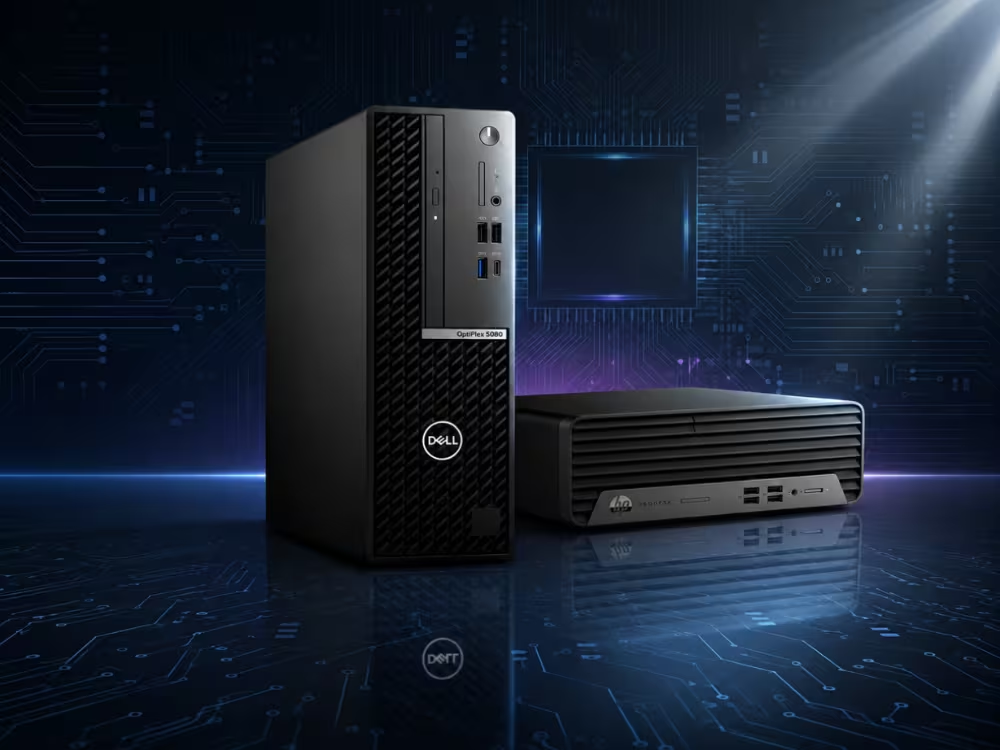
For years, the traditional desktop PC was exactly what you would expect from a desktop computer: a large box sitting underneath or beside your desk, with plenty of space inside for components, cables and upgrades.
That picture is changing.
Mini PCs have become increasingly capable, offering enough performance for a wide range of everyday tasks while taking up a fraction of the space. For businesses, schools and home users, that raises an interesting question: do we really need a large desktop computer anymore?
The answer, as with most things in technology, depends on what you need it to do.
Small Doesn't Necessarily Mean Underpowered
The idea of a small computer often suggests something basic, designed for simple browsing or streaming. Modern mini PCs have moved well beyond that.
Compact computers are now available with processors capable of handling everyday business applications, web browsing, video conferencing and multitasking with ease. For many users, a small form factor machine can provide everything they need without taking up valuable desk space.
That makes them particularly appealing in environments where space is limited or where businesses are trying to create cleaner, more flexible workspaces.
A smaller computer can sit neatly behind a monitor, underneath a desk or in another discreet location, helping to reduce clutter without compromising the essentials.
Where Mini PCs Make Sense
For many everyday computing tasks, a mini PC can be a perfectly practical choice.
They can work particularly well in offices, reception areas, classrooms, meeting rooms and other environments where users need reliable access to standard business software without requiring a high-performance workstation.
They can also be useful for businesses with larger numbers of employees. When you're buying dozens or hundreds of computers, the physical footprint of each machine starts to matter. Smaller systems can make better use of office space and simplify desk setups.
They can also be easier to move around when workspaces change, making them a useful option for businesses adopting more flexible office layouts.
When Bigger Really Is Better
Of course, mini PCs aren't the answer to everything.
Some users need more powerful hardware for demanding workloads such as video editing, 3D modelling, engineering software or other applications that require high-end graphics performance.
Upgradeability can also be more limited in some compact systems. While RAM and storage may be replaceable on certain models, there is generally less room for expansion than you would find in a traditional desktop tower.
For businesses, this is an important consideration. A computer that meets today's requirements might not be the right choice if you expect the user's workload to change significantly over the next few years.
The smallest computer isn't automatically the best computer. The right choice is the one that provides the performance you actually need, with enough flexibility to remain useful for as long as possible.
Smaller Computers and Energy Consumption
Size isn't the only reason mini PCs are attracting attention.
Many compact computers are designed around lower-power processors and efficient components, which can mean lower energy consumption compared with larger, more powerful desktop systems.
For an individual user, the difference may not be dramatic. Across a large business with hundreds of machines running throughout the working week, however, small differences in energy use can add up.
That said, it's worth looking at the bigger picture. A computer's environmental impact isn't determined by electricity consumption alone. Manufacturing, raw materials, transportation and what happens to the device at the end of its useful life all play a role.
A smaller computer may use less energy while it's running, but that doesn't automatically make it the greener option. How long it lasts, whether it can be repaired or upgraded and whether it can be reused at the end of its first life all matter too.
Could Smaller Mean Longer Lasting?
One of the most interesting things about the move towards compact computing is the potential to rethink how we use technology.
A business doesn't necessarily need to replace a computer simply because a newer model is available. If a device continues to perform the job it was purchased for, keeping it in use for longer can often make sense financially and environmentally.
This is where refurbished equipment can play an important role.
A refurbished business computer that still has plenty of useful life left can provide a practical alternative to buying new. Rather than every device following a simple cycle of purchase, use and replacement, businesses can look at how equipment can be kept in service for longer, redeployed elsewhere or passed on to another user.
That approach can reduce waste while making technology budgets go further.
So, Is Bigger Always Better?
Not necessarily.
For some users, a full-size desktop with plenty of room for expansion will still be the right choice. For others, a compact computer can provide everything they need while taking up less space and potentially using less energy.
The important thing is to choose technology based on how it will actually be used rather than simply opting for the biggest or newest option available.
As technology continues to become smaller and more efficient, the traditional desktop PC may become less common in some workplaces. But that doesn't mean the desktop is disappearing. It is simply changing shape.
And perhaps that's a good thing.
Looking for a Compact, Reliable Business PC?
If you're looking for a reliable desktop without the footprint of a traditional tower, refurbished business computers can be an excellent option.
At Rapid IT, we currently have refurbished HP ProDesk 400 G7 desktops available through the Rapid IT Store. With a 10th Gen Intel Core i5 processor, 8GB of RAM, a 256GB SSD and Windows 11 Pro, they're well suited to everyday business and home computing.
The small form factor design makes them a practical choice for offices and workspaces where desk space is at a premium, while buying refurbished gives a previously used business PC another useful chapter in its lifecycle.

Similar Insights
Practical knowledge, industry trends, and security insights, helping you make smarter IT decisions.

.avif)




.svg)